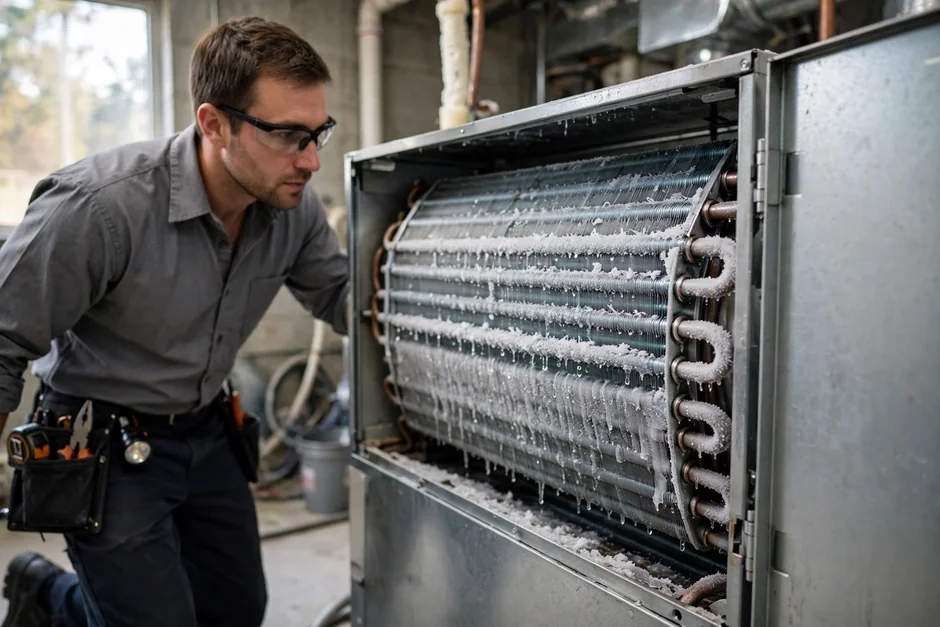
Cause One: Airflow, Checked First
Airflow problems are the most common reason coils freeze, and they are the cheapest to fix, so they are ruled out before refrigerant is even measured. A filter left in through a Tennessee pollen season can mat over and starve the coil. A blower running at the wrong speed, a coil coated in dust because filters were skipped, or too many closed vents do the same thing. In crawlspace homes, a crushed or disconnected duct run can quietly cut airflow to the whole system.
Cause Two: Low Refrigerant
When the filter is clean and the blower is moving air well, low refrigerant moves to the top of the list. Low charge drops coil pressure and temperature, so the coil freezes even with good airflow. Refrigerant does not get used up, so a low reading means a leak. Adding refrigerant without finding the leak usually means the coil freezes again within the season, and you pay for the same gas twice. Leak search and honest talk about the age of the system come before any recharge on our AC repair calls.
Why Running a Frozen System Causes Damage
- Compressor strain: A frozen coil can let liquid refrigerant reach parts of the system built for gas, which can damage the compressor.
- Water damage: A full thaw releases a lot of water at once. If the drain is slow or blocked, it overflows around the air handler, often into ceilings or closets.
- Hidden faults get worse: The blower and controls keep working against a block of ice, adding wear while cooling almost stops.
How to Thaw the System Safely
| Step | What to do | Why |
|---|
| 1. Stop cooling | Set the thermostat to Off or Fan only | Stops more ice from forming |
| 2. Run the fan | Set Fan to On, not Auto | Warm indoor air melts the ice steadily |
| 3. Replace the filter | Fit a clean filter while it thaws | Removes the most common airflow cause |
| 4. Watch the drain | Check for water around the air handler and clear towels if needed | A thaw releases stored water quickly |
| 5. Wait, then test | Allow several hours for a full thaw before running cooling again | Testing a half frozen coil gives false readings |
One honest caution: if the coil freezes again within a day or two of a thaw and a clean filter, the cause is still there. Refreezing after a proper thaw is one of the clearest signs the system needs testing rather than another reset. A seasonal AC maintenance visit, with coil and drain checks plus a filter routine, prevents most of the airflow side of this problem, and duct cleaning helps homes where dust keeps loading the coil despite regular filter changes.