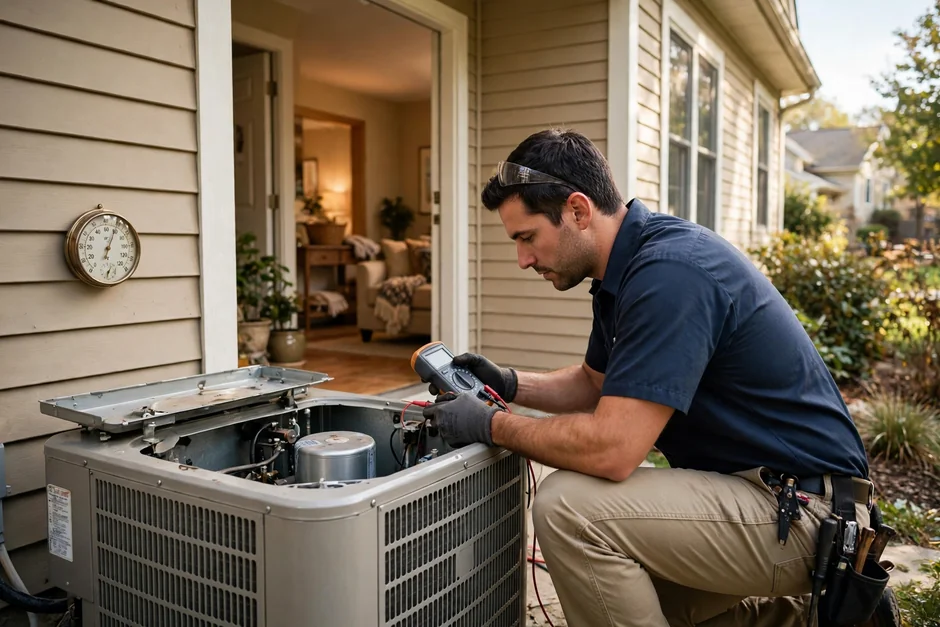
The Triage Order: Capacitor, Coil, Refrigerant
First, the capacitor. It gives the compressor and fan motors their starting push. A weak capacitor is the single most common no-cool call we see, and it often fails on the hottest afternoon of the year. Signs include a humming outdoor unit, a fan that needs a nudge to start, or a system that trips and resets. A capacitor test takes minutes with a meter, and guessing wrong here wastes money.
Second, the coils. A dirty outdoor condenser coil cannot release heat, so the system runs longer and cools less. Cottonwood, grass clippings, and dust build up fast in Rutherford County summers. The indoor evaporator coil matters too: a matted filter lets dirt reach it, and a frozen coil means almost no cooling until it thaws.
Third, refrigerant. Low charge means a leak, because refrigerant does not get used up. Topping off without finding the leak buys a few weeks at best. We measure pressures and temperatures, confirm the charge, and talk honestly about leak repair versus the age of the system before you spend on refrigerant.
Quick Checks You Can Do Safely
- Filter: Hold it to the light. If you cannot see light through it, replace it and give the system an hour.
- Thermostat: Confirm Cool mode, fresh batteries if it uses them, and a set point below room temperature.
- Outdoor unit: Clear leaves and grass at least a foot out on all sides. Note whether the fan spins and whether the unit hums without starting.
- Vents and ice: Check supply vents for weak airflow and look for ice on the copper line at the outdoor unit. Ice means switch to Fan mode to thaw and call.
- Breaker: A tripped breaker you reset once is a clue. A breaker that trips again is a fault, not bad luck.
Causes at a Glance
| Cause | What you notice | What settles it |
|---|
| Weak or failed capacitor | Humming unit, fan slow to start, no cool air | Capacitance test with a meter |
| Dirty condenser coil | Long run times, house stuck in the 80s | Coil inspection and cleaning |
| Low refrigerant from a leak | Weak cooling, ice on the line, hissing in some cases | Pressure readings and leak search |
| Frozen evaporator coil | Very weak airflow, water around the air handler | Thaw, then airflow and charge checks |
| Clogged filter or blocked vents | Uneven cooling, system running nonstop | Filter change and vent check |
Homes in Lake Forest Estates and Heritage Valley with 15 to 20 year old systems hit this decision point often: a capacitor or coil cleaning is a clear repair, while a major refrigerant leak on an old unit deserves the repair versus replace talk in our repair or replace guide. If the house is in the high 80s with kids, older adults, or pets inside, treat it as urgent and see our emergency HVAC repair page.